
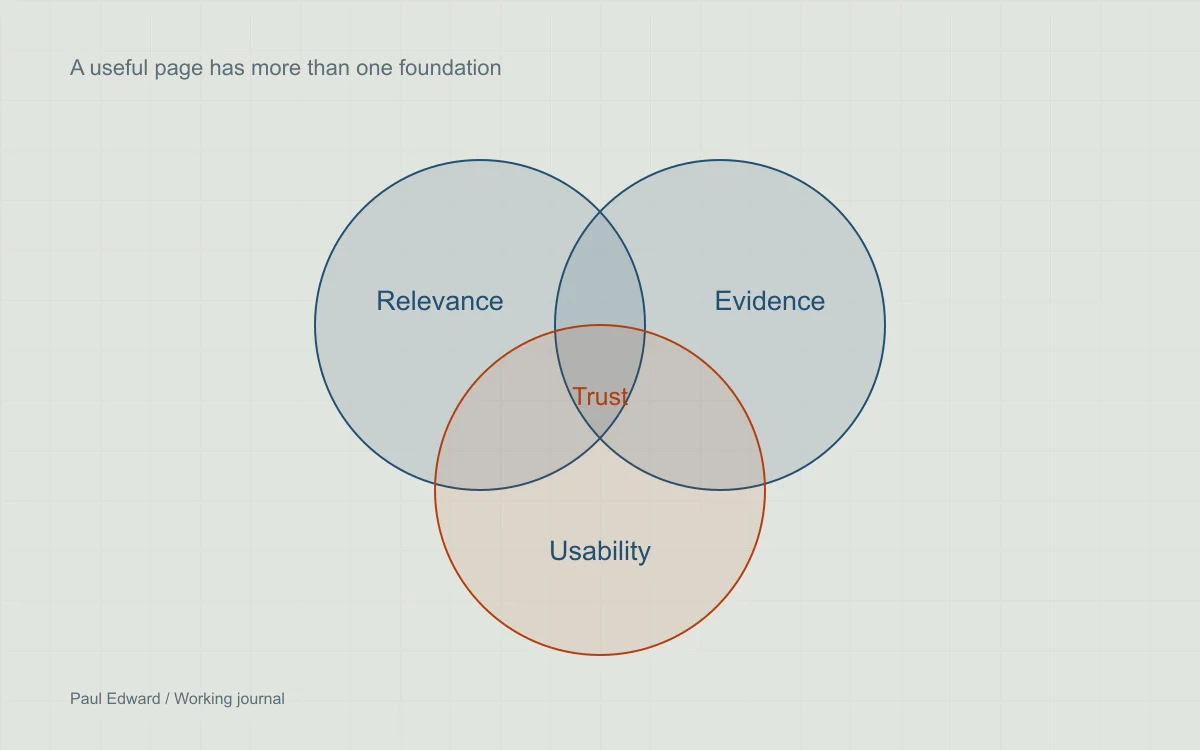
Separate documentation from speculation
It is tempting to reduce search ranking to a weighted checklist. Google publishes useful guidance about its systems, but it does not provide a universal set of numerical weights for a site owner to optimize. Claims that INP has a precise multiple of another metric’s ranking weight need evidence that public guidance does not supply.
A correlation study can suggest questions to investigate. Without the dataset, sampling method, controls and limitations, a coefficient or traffic-growth chart is not a reliable basis for a technical decision. Even a well-designed observational study does not automatically establish causation.
What Core Web Vitals can tell you
LCP, INP and CLS describe loading, responsiveness and visual stability. They are useful measures of real visitor experience. A good score does not establish that the article answers a query better than another page, and a perfect Lighthouse result is not a promise of first position.
Use field data to identify affected templates, then reproduce the problem in development tools. Distinguish a loading test from an interaction test. Do not convert one lab run into a claim about every visitor.
What E-E-A-T means for an article
Experience, expertise, authoritativeness and trustworthiness provide a framework for evaluating content quality. Google explicitly says E-E-A-T itself is not a specific ranking factor. Adding an author schema or a biography does not manufacture experience.
Give readers reasons to trust the particular page: identify the author, cite primary evidence, explain the conditions of an example, and distinguish tested results from recommendations. When you have an original case study, publish the measurement method and relevant limitations with the client’s permission. If you do not have that evidence, present the article as guidance.
Helpful content and AI-assisted writing
Assess the result by what it helps a reader do. Correctness, original value and clear evidence matter more than a claim that content was produced by a particular method. Scaled production intended to manipulate rankings can violate spam policies regardless of how the text was made.
A useful editorial review checks technical examples, resolves contradictions, removes invented results and asks whether the reader can act on the explanation. Avoid padding a page to meet an arbitrary word count or changing its date without a meaningful update.
Diagnose a ranking or traffic change
- Confirm the measurement: compare similar time periods and account for seasonality, device, country and branded demand.
- Check availability, indexing, canonical selection and recent redirects before rewriting content.
- Separate impression changes from click-through changes. A different search layout can affect clicks without the same change in demand.
- Group affected pages by template and topic, and inspect whether the page still satisfies the query.
- Review documented search updates, but do not assume an update caused every coincident change.
- Make a focused improvement, record its deployment date and give the data time to become interpretable.
Frequently asked questions
Can you guarantee an AI citation or a number-one ranking?
No. Search and answer systems decide which sources to display for each query. Clear, accessible, well-supported content improves the page itself and its eligibility to be understood. It does not reserve a result position or guarantee that an AI answer will cite it.
Does Google publish exact ranking weights for Core Web Vitals?
No universal numerical weighting formula is provided in the guidance cited here. Use Core Web Vitals to understand experience problems, and avoid turning correlations or single tests into claims about a fixed ranking boost or penalty.
Can I improve E-E-A-T by adding an author schema alone?
Markup can identify the author, but it cannot create experience or expertise. Provide relevant evidence, clear authorship, primary references and accurate explanations. Google describes E-E-A-T as a quality framework rather than a single ranking factor you can set.
What should I investigate before rewriting a page after traffic drops?
First check availability, indexability, canonical selection, redirects and measurement changes. Compare similar periods by query, device and country, and distinguish impressions from clicks. Then assess whether the page still meets the reader’s need and record any focused changes you make.
Sources and further reading
- Google: Ranking systems guide
- Google: Helpful, reliable, people-first content
- Google: Core Web Vitals and Search
- Google: Spam policies
Keep exploring
Apply the technical SEO checklist and address measured performance issues.
Leave a Reply