
There is no universal fastest architecture
A cached response near the visitor can be fast regardless of how the HTML was originally generated. A server-rendered page with efficient queries may outperform a static page that ships excessive JavaScript. TTFB, content freshness and responsiveness are different properties.
This comparison is a decision framework, not a benchmark of client systems. Framework version, runtime, hosting adapter, cache configuration, geography and data access all affect results.
Compare the work each approach performs
| Approach | When HTML is produced | Good starting use | Check carefully |
|---|---|---|---|
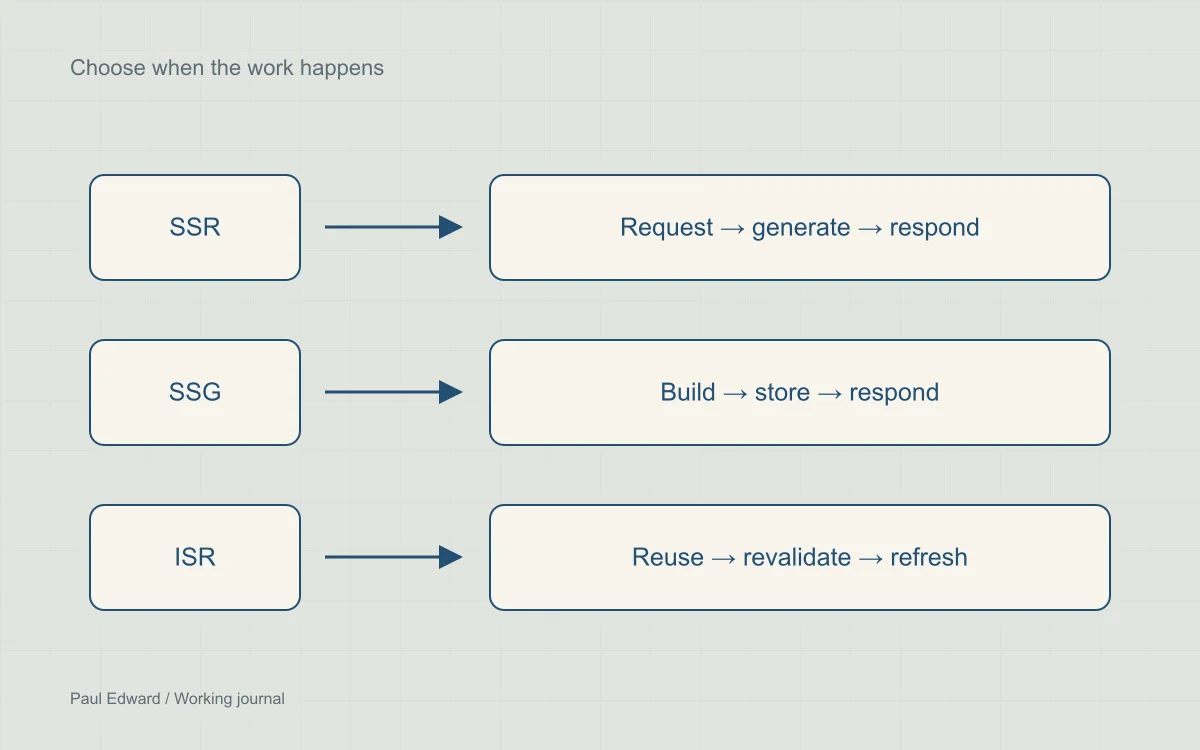
| SSR | During a request, subject to caching | Authenticated or request-specific pages | Origin work, timeouts and private cache boundaries |
| SSG | Before a visit, commonly during a build | Stable editorial and documentation pages | Build duration and publication delay |
| ISR | Generated output reused and refreshed | Public content with bounded staleness | Invalidation, regeneration failure and first uncached visit |
Use SSR when the request changes the answer
Account pages and permission-sensitive views often need request-time decisions. Keep authentication and authorization on the server and prevent shared caching of private responses. Streaming, data caching and careful query design can reduce waiting, but do not eliminate the need to measure.
SSR does not imply a particular infrastructure price or a mandatory cluster size. Load, response work and scaling strategy determine those requirements.
Use SSG when publication can happen ahead of visits
Prebuilt HTML can be served through ordinary static hosting or a CDN. It is a strong starting point for content that changes predictably. Check how long a realistic build takes and how editors see drafts before publication.
Not every static system rebuilds every page for every edit; incremental build behavior depends on the tool. Test image processing, content fetching and deployment time as well as page rendering.
Use ISR when bounded staleness is acceptable
ISR combines generated output with regeneration. In Next.js Pages Router, a revalidation interval allows a later request to trigger refresh after the interval has elapsed; it is not a timer that guarantees fresh content at an exact second. Cached output may remain visible while regeneration happens.
Validate the behavior of first visits, failed regeneration and on-demand invalidation on your actual hosting platform. API names and support differ by router and framework version. Do not assume an edge runtime supports the same regeneration features as a Node.js deployment.
Public product descriptions can often tolerate some staleness, but the authoritative price, inventory and payment decision should be checked in the transaction flow. Never let an old cached page become the sole source of truth for a purchase.
Run a comparison you can reproduce
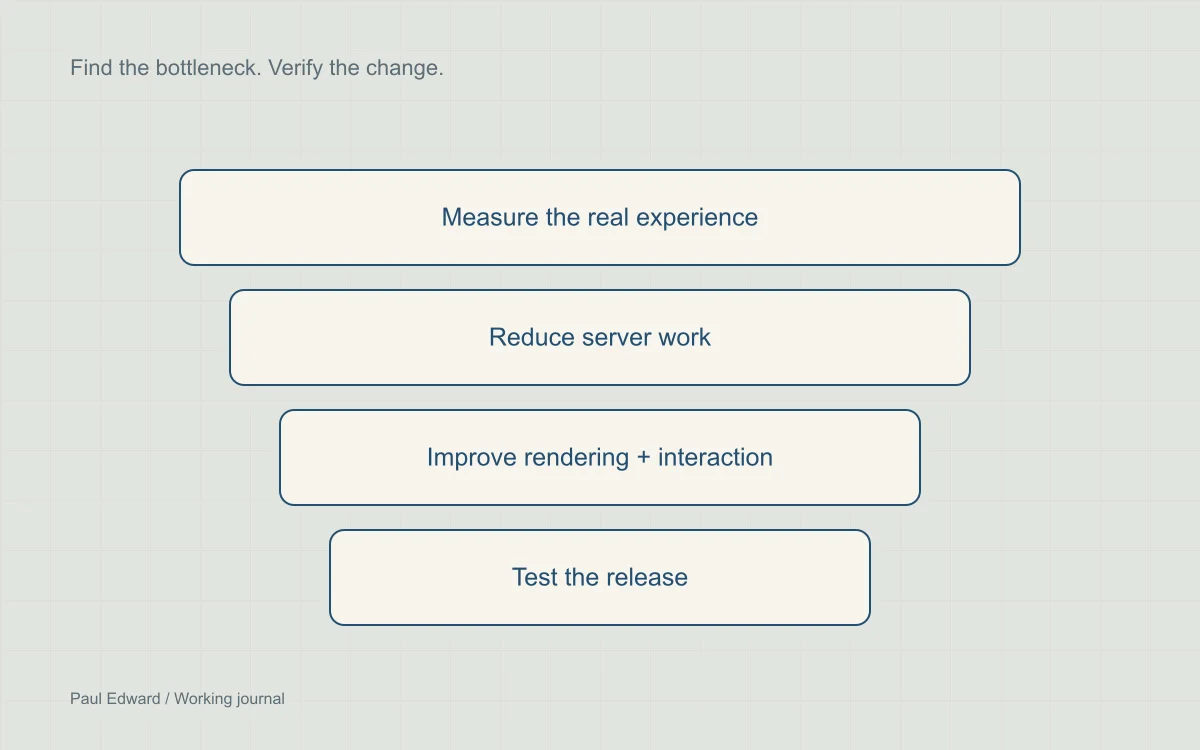
- Use identical content, images and equivalent interaction behavior across implementations.
- Record framework version, runtime, server region, CDN, database region and cache policy.
- Test cold and warm requests separately, including regeneration and origin failure.
- Measure several locations and realistic concurrent workloads; record sample count and latency distribution.
- Compare LCP, transferred bytes and interaction traces as well as TTFB.
- Test publishing, unpublishing, permission changes and rollback with the team that will maintain the site.
Frequently asked questions
Can you mix strategies?
Yes. A journal, a product catalogue and a private dashboard can have different rendering and caching needs. Define those boundaries explicitly and keep the number of operational modes small enough for your team to test.
Which rendering strategy is best for a business blog?
Prebuilt or cached public HTML is often a useful starting point when content changes predictably. The right choice also depends on preview, publishing delay, integrations and maintenance. Benchmark the complete page, including images and interaction work, rather than only the first response byte.
Does an ISR revalidation interval guarantee an immediate update?
No. Behavior depends on the framework and deployment. In the Next.js Pages Router model described above, a later request can trigger regeneration after the interval, while a previously generated response may remain available. Test failed refreshes, first uncached visits and on-demand invalidation.
Can private account pages use the same shared cache as a public article?
Private or permission-sensitive responses need deliberate boundaries and must not leak through a shared public cache. Establish authorization before returning protected information. Public editorial pages and authenticated account pages can use different rendering and cache policies.
Sources and further reading
- Next.js: Incremental Static Regeneration, Pages Router
- Next.js: Server-side rendering, Pages Router
- Google: Web Vitals
Keep exploring
Compare headless and traditional WordPress, then use the performance measurement workflow.


Leave a Reply